The Virginia Living Museum is fortunate enough to have in its collections one of the most remarkable mastodon specimens yet discovered in Virginia: the Hart-Fiscella Mastodon. What is the story of this remarkable find? Why is it so incredible? What even is a mastodon? Read on and find out!
Meet the Mastodon
The American mastodon (Mammut americanum) is an extinct mammal distantly related to mammoths and modern elephants. With a long trunk and large tusks (modified incisor teeth), it was similar in shape to its relatives but was a bit stockier and had proportionally shorter legs.
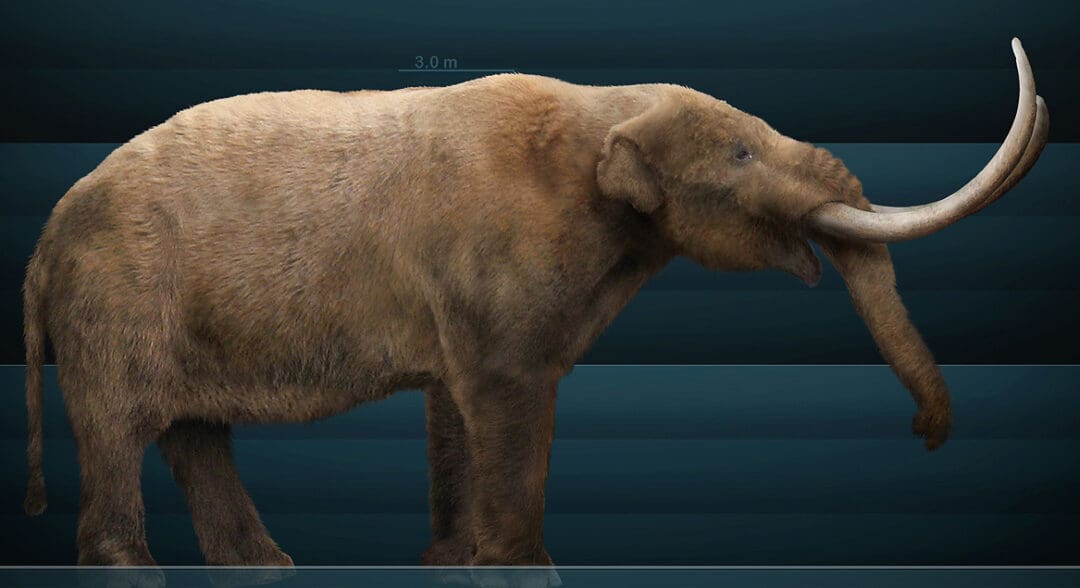
The American mastodon (Mammut americanum). Art credit: Sergiodlarosa
Where in the World?
While fossils of the American mastodon can be found throughout North and Central America, it appears to have been most common in the eastern United States. The American mastodon lived primarily in forests, unlike the grassland-dwelling mammoths. The earliest appearance of the American mastodon in the fossil record is a ~3.75 million-year-old specimen from Washington State. Like many other “Ice Age” animals, the American mastodon survived until the end of the most recent glacial period, approximately 11,700 years ago.
Differing Diets
One major difference between the American mastodon and the woolly mammoth is the shape of their teeth. Woolly mammoths had flat teeth with small ridges used to graze on tough grassland plants. They would slide these teeth back and forth to grind their food. The mastodon had teeth with tall ridges and cones, which were used for browsing on softer plant material like fruits, leaves, and twigs. These differing diets allowed these two species to coexist without competing with one another for food in areas where their ranges overlapped.
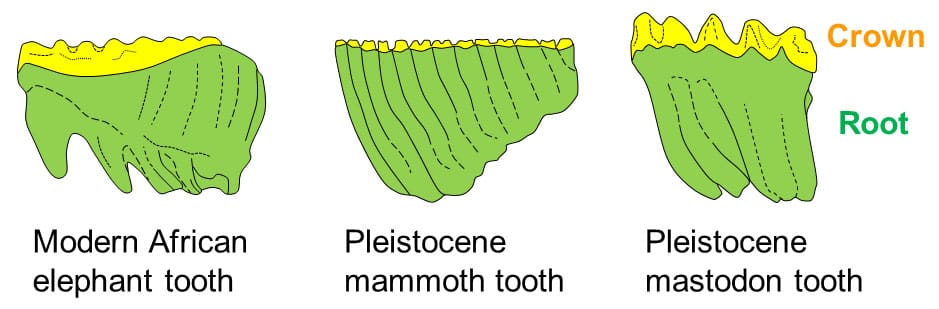
Figure highlighting the differences between an elephant tooth (left), mammoth tooth (center), and mastodon tooth (right).
Figure credit: Kentucky Geological Survey
The Hart-Fiscella Mastodon
The first remnants of the Hart-Fiscella Mastodon were found in 1983 by a brick mason named Lawnell Hart. While hunting game two miles west of Yorktown, Lawnell found an odd-looking rock jutting out of a creek bed. Puzzled, he was able to get the object identified by Dr. Gerald “Jerre” Johnson, a geology professor at the College of William and Mary. It turns out that the “rock” was actually a mastodon tooth! Lawnell and Jerre went back to the site with the intent to continue the excavation, but were unable due to permissions regarding the land.
In 2015 (over thirty years later!), the new landowners Edward and George Fiscella not only allowed Jerre to continue the excavation but even helped clear the land! Jerre then assembled a ragtag group of volunteers to exhume the mighty beast. This enthusiastic group worked tirelessly from late July until early November of that year – sometimes for five or six days a week! After the excavation came to an end, it was found that the team had recovered approximately fifteen percent of the skeleton. At the time, this was considered the second-most complete mastodon specimen discovered east of the Blue Ridge Mountains – truly a very special find.
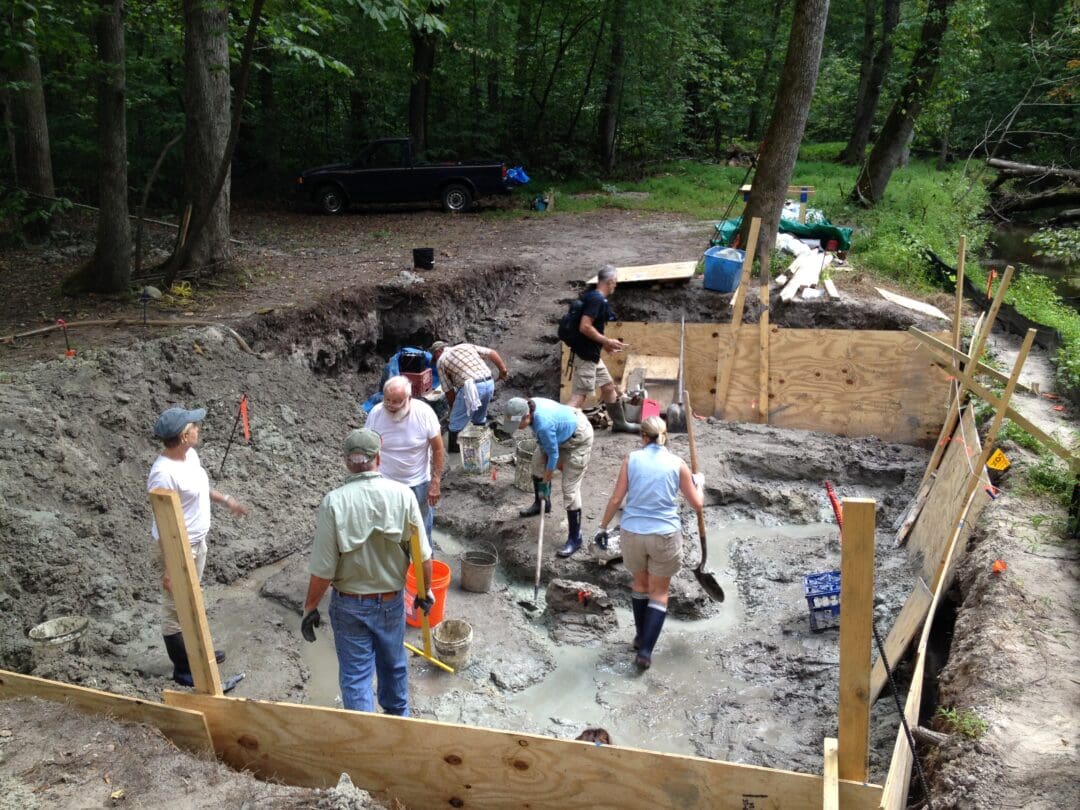
The excavation of the Hart-Fiscella Mastodon led by Dr. Gerald “Jerre” Johnson (third from left).
The story doesn’t end there! In 2017, the bones were generously donated to the Virginia Living Museum with the hope that the specimen would one day be displayed for the community to enjoy. Meanwhile, the fossils continued to be studied by other researchers. Many of the bones were digitally scanned by Dr. Bernard Means at Virginia Commonwealth University for use by their Virtual Curation Laboratory. Several years later, Dr. Adam Pritchard from the Virginia Museum of Natural History was hired to conduct an in-depth report of the entire specimen. After the report had concluded, the
specimen sat in the VLM’s collections waiting to be prepared…
In May of 2024, preparation on the mastodon finally began. After more than nine months and lots of blood, sweat, and tears (and a whole lot of glue) from the chief fossil preparator and many others, the specimen was fully prepared and ready for exhibition! Exhibition plans are currently in development and the hope is that the first few pieces will be out on display as soon as late summer 2025.

The right tusk of the Hart-Fiscella Mastodon.
Why Does the Mastodon Matter?
Aside from the scientific importance of such a find (it’s not every day that a relatively complete mastodon is unearthed in Virginia!), the Hart-Fiscella Mastodon is also of great importance to the local community. Everything about the Hart-Fiscella Mastodon’s story, from its discovery and excavation to its study and preparation, highlights the collaborative nature of science. No one could have completed this project on their own. It took the collaborative effort, resources, and passion of an entire community to get this mastodon to where it is today. Perhaps most importantly, it shows that anyone can be a scientist – sometimes all it takes to make a new discovery is a keen eye and a bit of curiosity.
See the Mystery Come to Life
The story of the Hart-Fiscella Mastodon is still being written—and you’re invited to be part of it. Whether you’re a lifelong learner, a fossil enthusiast, or just someone who loves a good mystery, there’s no better time to explore the collections at the Virginia Living Museum.
Visit our Collections to get a closer look at this incredible Ice Age specimen and others that reveal Virginia’s ancient past.
Join us for a Mastodon Talk to hear behind-the-scenes stories from the excavation, learn how fossils are prepared, and discover why this find matters to both science and the community.
Curiosity sparked something big back in 1983—and it might again, in you.
Written by Alec Zaborniak, our Non-live Collections Manager.