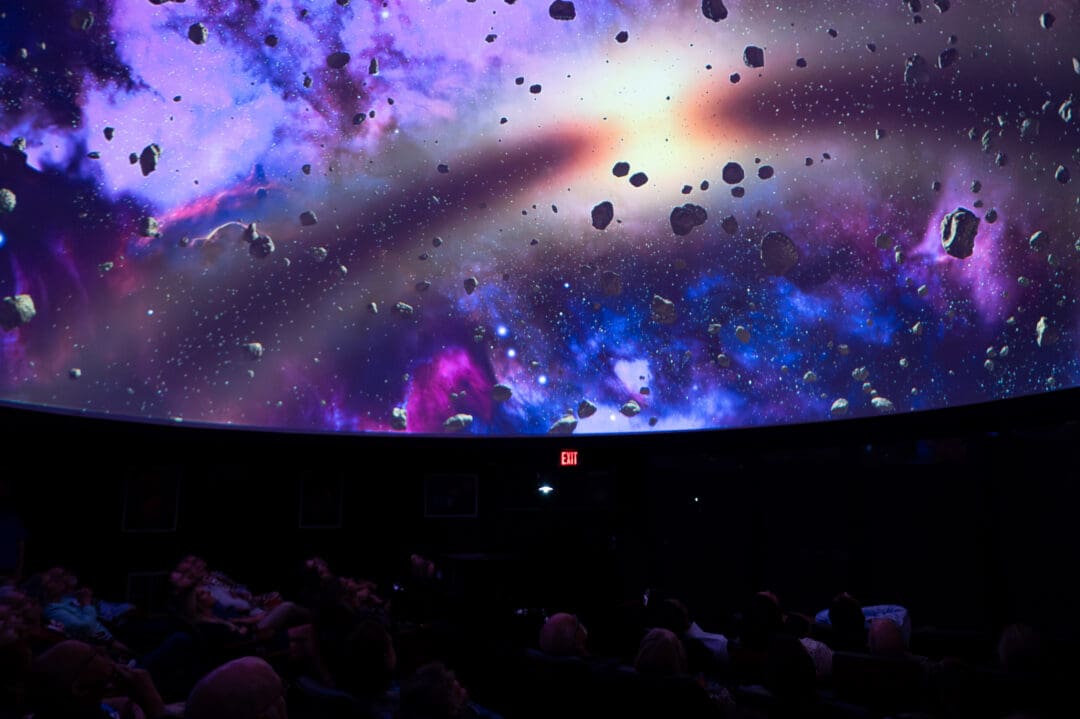
Summer is almost over, and that means cooler nights are on the way. Nights just perfect for getting outside and doing a little observing. In preparation for the arrival of those delightful autumn evenings, let’s take a look at where the planets will be during the month of September.
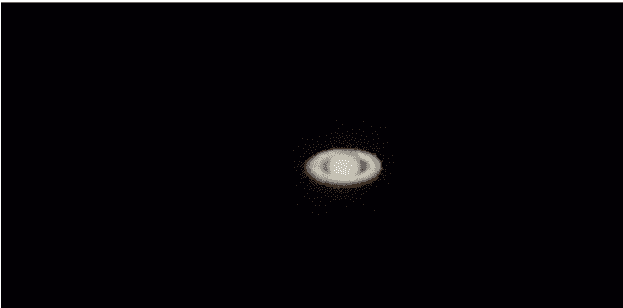
Saturn as seen through a small telescope. Image courtesy VLM volunteer Kevin Herrera.
Is it a Planet or a Star?
When you look up at night…well…everything looks like a star. However, not all ‘stars’ are actually stars! Planets, nebulae, and even galaxies have been mistaken for stars in our night sky. Here’s a few tips on how to tell the difference between the stars, and our planetary neighbors.
- Planets don’t twinkle as much as stars. Twinkle, twinkle little star…not twinkle, twinkle little planet. The reason why planets don’t twinkle as much as the stars is very simple – planets are an awful lot closer to us than the stars are. That means the light we receive from a planet is strong and steady, and not as easily bounced around by our moving atmosphere as the tiny bit of light reaching us from a star. If you see a bright object in the sky that does not appear to twinkle much, it’s almost certainly a planet.
- Planets are generally brighter than the surrounding stars. Once again, distance plays a role here. Since the planets are right nearby, they do a great job of reflecting sunlight back us, allowing them to shine brilliantly in our sky. Large planets like Jupiter and Saturn have an advantage due to their great surface area, while nearby planets like Mars and Venus get the benefit of the light not having to travel as far. If you see something unusually bright in your sky, chances are good it’s a planet.
- Planets are always found in the southern sky. Since all of the planets in our solar system orbit around the Sun, they all appear in an arc that stretches across our sky. Astronomers call this arc the ecliptic. For the northern hemisphere, the ecliptic is always across the southern part of the sky. Like all other celestial objects, planets rise in the East and set in the West. You’ll never see planets in the northern sky.
There are a handful of stars that do outshine the fainter planets, but in general, look around the southern portion of the sky for bright objects. If they aren’t blinking, twinkling, or flashing, you’ve probably spotted one of the other denizens of our solar system.
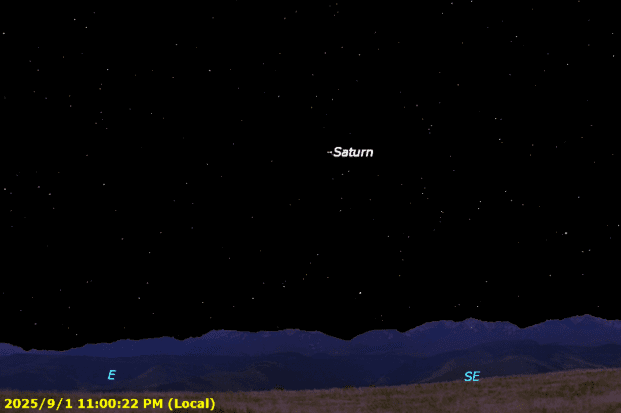
Saturn on Sep 1, 2025 at 11pm. Image created with Starry Night.
The Delight of the Night
So now that you know roughly what to look for…what should you actually be looking for? One thing to remember is that, just like the Earth orbits the Sun, so do all the other planets. And they all do so at different speeds. Therefore, the planets are not seen in the same place in the sky at the same time of year like the constellations. You’ll need to check on what planets are going to be visible on whatever date you want to check out the sky. You can get a sky map for the current month showing the planets at https://www.skymaps.com/downloads.html
For the month of September this year, it just so happens that only one planet will be visible in the sky during the evening hours. Don’t despair, however, because it’s pretty much the coolest planet of them all: Saturn. The incredible ringed giant will be rising in the east late in the evening during the start of the month, but will rise earlier and earlier as the month progresses. Look towards the eastern sky after sunset for a golden yellowish object. Saturn is about a billion miles away from us, so it isn’t impressively bright, but it will still outshine many of the other stars in its area of the sky.
Finally, remember, that with the unaided eye, planets always look like stars – simple pinpoints of light. To see more details of Saturn, including the gorgeous rings, you’ll need a telescope.
The Benefits of Being an Early Riser
So if Saturn is the only planet visible in the evening, where are all the others? Uranus and Neptune are too far away from us to be visible with the unaided eye, so we generally don’t worry much about them. Mercury and Mars will both be in roughly the same direction as the Sun during the month of September, making them almost impossible to view. However, that leaves the two brightest planets as a treat for those who don’t mind getting up before the Sun.
Venus and Jupiter will both be visible in the eastern sky before the sunrise. You can’t miss them – Venus is the brightest object in the sky after the Sun and Moon, and Jupiter is only slightly fainter. The two objects will be reasonably close to one another in the early part of September, but then will separate as the month goes on, Venus sinking lower towards the horizon and Jupiter climbing upward, rising earlier and earlier.
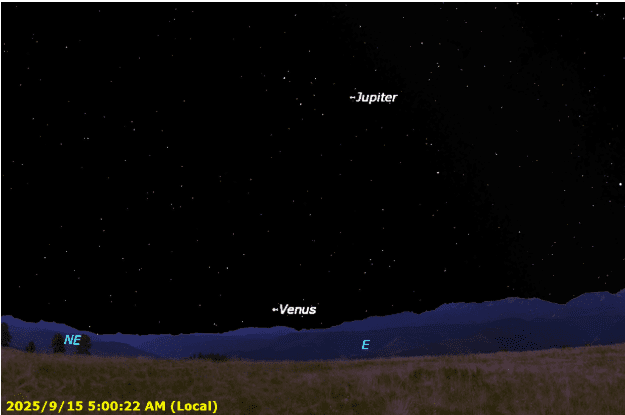
Venus and Jupiter on Sep 15, 2025 at 5AM. Image created with Starry Night.
How to Get a Great View of the Planets
Want to make sure you get to see the best view of the planets that you can? The Virginia Living Museum can help you achieve that goal.
- Rent a Telescope
Having a telescope available will take your planet-gazing to a whole new level. Our telescopes rent for only $10 per night, and include a brief primer on set up and use. - Attend a Monthly Stargazing Night
Get outside with our telescope jockeys and let them show you the planets! On the second Saturday of every month, we open our observatory and planetarium theater in the evening for live sky observing and laser shows. Observing is free and open to the public. Shows in the planetarium require a paid ticket. - Book a Private Stargazing Session
Want to see the planets, but want someone else to do all the leg work? We can help. Private observing sessions can be booked either at your location, or at the museum.
To learn more or to sign up for any of these opportunities, visit our website thevlm.org or contact our astronomy manager directly at [email protected]. The planets await!
Written by Kelly Herbst, our Astronomy Manager.