The VLM Salamander Survey started in fall of 2022 as a biomonitoring survey to determine which species of terrestrial salamanders are present at 4 small sample sites on VLM property. Each survey site consists of 50 ceramic tile squares which serve as moisture refuges for the salamanders who navigate the forest floor and the soil beneath. The animals use the tiles as feeding and breeding territories and can be checked routinely by research volunteers for the presence of salamanders.
The goal of the project is to monitor forest floor salamander biodiversity, determining which species are present and in what density, and to include citizen scientists (VLM guests and volunteers) in the process of learning about the scientific process and the importance of these small creatures in their forest floor ecosystem.
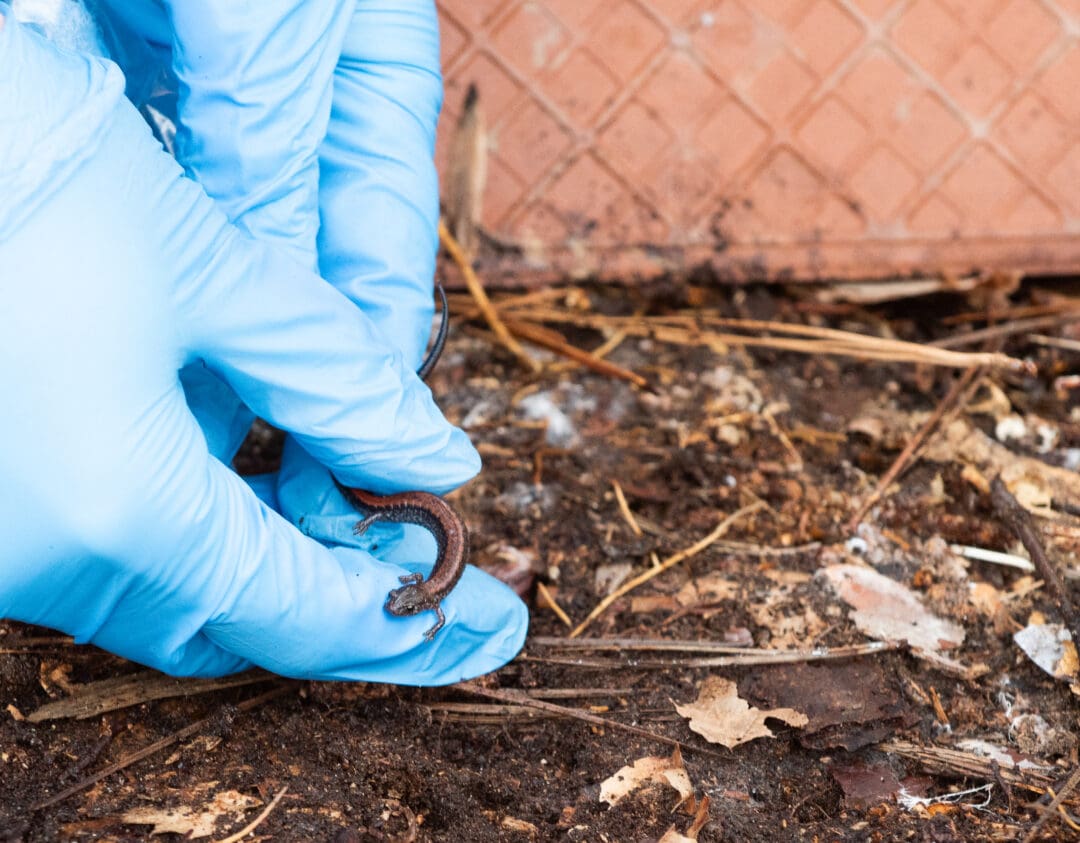
The primary focal species of this survey is the Eastern Red-backed Salamander (Plethodon cinereus). This small-bodied salamander is by far the most abundant and wide-ranging species across much of its range in the north-eastern United States. This species is a member of a family of lungless salamanders (known as Plethodontidae) that live in a terrestrial environment, despite not having lungs, and take in oxygen directly through their moist, permeable skin. For this reason, they require a moist habitat or refuge (under leaf litter or cover objects, like our tiles) to prevent drying out.
This species is also territorial and polymorphic, meaning they have 2 genetically distinct color morphs: the red-striped phase (with a red stripe running down the center of the back) and the lead or unstriped phase (with no red stripe, and an otherwise unmarked black or metallic colored back). The red-backed salamander is small, growing to an adult size of 2-5 inches long, but plays a very important role in the forest floor food web as both a predator to the numerous soil microinvertebrates and prey to many birds, mammals, amphibians, and reptiles that inhabit eastern deciduous forests.
Each salamander that is found under a tile is measured (length and mass), sexed (male or female), and given an individual identification number which corresponds to a marking code. The animal is then marked with a visual implant elastomer (VIE), which is essentially liquid that hardens into a rubbery implant that is visible through the skin of the animal, (don’t worry, this doesn’t hurt the animal… it’s similar to implanting a “low-tech” microchip). The research team can then use the marking to ID the animal in the future to track its growth, survival, territory use/site fidelity, and mate choice. In addition, some environmental data is also taken from each capture site including leaf litter depth, canopy cover, soil moisture and temperature, and air temperature and relative humidity. All of this data will be used to make inferences about environmental effects on salamander habitat use and surface activity patterns.