Options for Educators:
Museum Visit
Schedule a museum visit to explore over 250 live animal and plant species, native to Virginia, in their natural settings. Your students can experience hands-on learning in our discovery centers and interactive galleries.
Length of Visit
Allow 1.5 to 2 hours for a tour of the indoor exhibits and outdoor trails.
Fee
$10 per student (September – mid-June)
Classroom teachers and school staff are free. One chaperone is recommended for every 10 students and is admitted free. Additional chaperones are $18 each.
For more information or to make a reservation, call the Reservations Coordinator at 757-534-7410 Monday-Friday, 8:30 am – 4:00 pm, or complete the Reservation Request Form below.
Reservation Request Form
Use our online form to schedule your school visit to the Virginia Living Museum or call 757-534-7410 Monday through Friday, 9am to 4:30pm
Funded in part by Harry and Judy Wason
Exhibits
The exhibits in the Virginia Living Museum correlate with and reinforce Virginia’s Standards of Learning for Science. While taking a tour of the geographic regions of Virginia, students can observe:
- Live animals and plants in their natural habitats
- Plant and animal life cycles, food chains, and food webs
- Animal survival adaptations for finding food and shelter, rearing young, avoiding predators, defensive measures
- Animal migration, camouflage, and hibernation
- Endangered and threatened species
- Vertebrates and invertebrates
- The importance of conserving Virginia’s animal, plant and mineral resources
- Pond, forest, stream, Chesapeake Bay, cypress swamp, mountain cove, cave and more habitats
- Virginia’s prehistoric past: rocks, minerals, fossils
Self-Guided Exhibit Guides
The Virginia Living Museum has developed targeted guides to help students focus during their visit. Teachers will need to come prepared with copies for their students.
Chaperone Guides
The Virginia Living Museum has developed these guides to help teachers and parent chaperones support student learning in the museum exhibits. These guides include a museum map, review of expectations, and guided questions to ask students while exploring the exhibits.
Classes
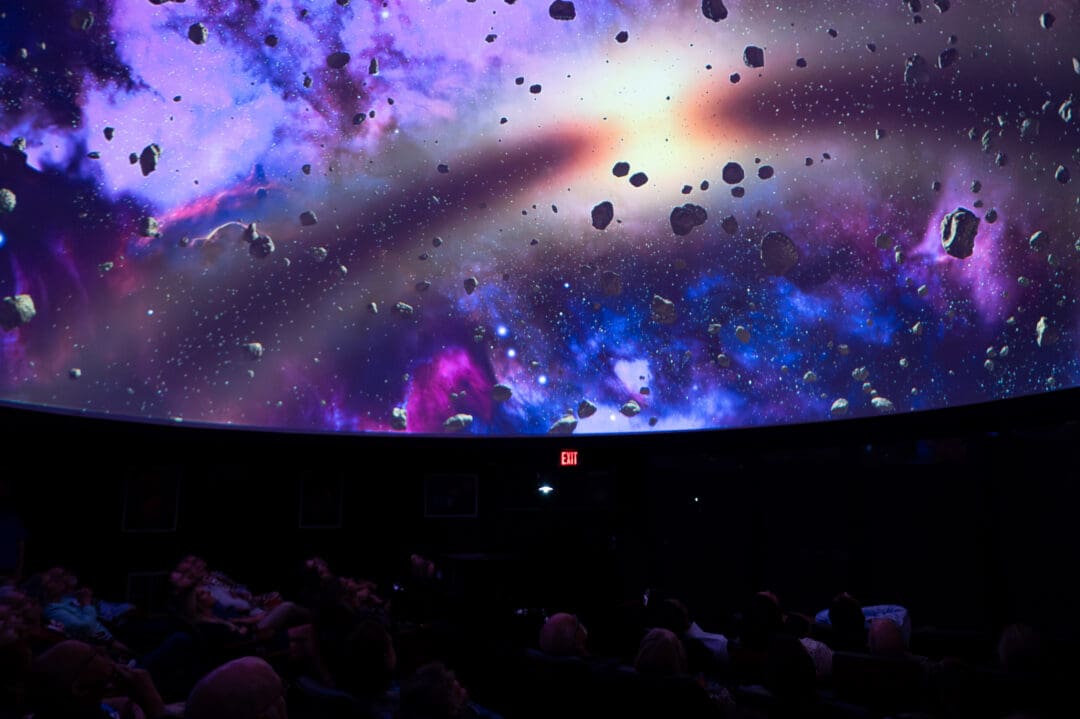
Add a science program, lab, or planetarium program to your museum visit. Options available for ages Pre-K through high school.
For more information or to make a reservation, call the Reservations Coordinator at 757-534-7410 Monday-Friday, 8:30am – 4:00pm or complete the reservation form below.
Length of Visit: 2-3 hours to include time to explore the museum when not in classrooms.
Labs Grades 6-12
These in-depth inquiry-based sessions have students actively conducting experiments, collecting data, and analyzing results.
Length of Session: 1.5 hours
Number of Students: 30 maximum
Fee: $16.00 per student (includes self guided visit of exhibits)
Classroom teachers and school staff are free. One chaperone is recommended for every 10 students and is admitted free. Additional chaperones are $18 each.
*Minimum requirement to book programs: 15 students September – February and 30 students March – June
Funded in part by VuBAY FOUNDATION.
Middle School Labs (Grades 6-8)
Chesapeake Bay Ecology
Science SOLs: 6.1, 6.8, LS.1, LS.5, LS.6, LS.8, LS.9, PS.1
Challenge your students in our station-based lab to improve data collection skills, critical thinking, and understanding real-world issues as they impact our Bay. This program provides a well-rounded view on the ecology of the Bay while inspiring a sense of stewardship to protect our environment.
School Safaris
Journey out into the field for an unforgettable hands-on learning experience.
Length of Session: 6 to 12+ hours (varies with topic)
Number of Students: Varies depending on program type
Fee: $35 per student ($700 minimum per program)
Fuel surcharge may apply. ALL safari bookings will be required to provide their own transportation to the site.
For more information or to make a reservation, call the Reservations office at 757-534-7410 Monday-Friday, 9am – 4:30pm or complete the online request form.
Funded in part by BayPort Credit Union.
Outreach Programs for Students
Have the Virginia Living Museum Visit You!
Outreach programs are fun and engaging presentations for classrooms, libraries, organizations, church groups, and retirement centers. A Virginia Living Museum educator will introduce your group to a variety of science topics through the use of live ambassador animals, museum artifacts, and active participation in an exciting ‘hands-on’ format. Programs are specifically designed to function as both an introduction to SOL topics and as reinforcement of previously taught science concepts.
For more information or to make a reservation, call the Reservations Coordinator at 757-534-7410 Monday-Friday, 8:30am – 4:00pm or complete the reservation request form.
Length of Program: PreK – 20 minutes; K – 30 minutes; Grade 1 and up – 45 minutes
Program Fee: $250 first program; $220 consecutive programs
Travel fee may apply.
Funded in part by TowneBank and Junior League of Hampton Roads.
Outreach Classroom Based Programming (K-12)
Curious Critters (PreK-5th; max 30 participants)
Building Blocks 1, 5; Science SOLs: K.1, K.6, K.7, 1.1, 1.5, 2.1, 2.4, 2.5, 3.1, 3.4, 4.1, 4.3, 5.1
Meet a variety of animal critters and discover their role in the ecosystem.
Food Chain Connections (K-5th; max 30 participants)
Science SOLs: K.1, K.6, K.7, 1.1, 1.4, 1.5, 2.1, 2.5, 3.1, 3.4, 4.1, 4.3, 5.1
Let’s start at the bottom of the food chain. Together we’ll work to make a food web and discuss why different animals eat different things.
Let’s Be A Scientist (K-5th; max 30 participants)
Science SOLs: K.1, K.5, K.7, 1.1, 1.5, 2.1, 2.5, 3.1, 3.5, 4.1, 4.3, 5.1
Develop science skills like observing, predicting, classifying, interpreting, and measuring to better understand the natural world.
Wild Adaptations (K-5th; max 30 participants)
Science SOLs: K.1, K.6, K.7, 1.1, 1.5, 1.7, 2.1, 2.4, 2.5, 3.1, 3.4, 3.5, 4.1, 4.2, 5.1
Uncover how wild animals survive through hands-on activities that demonstrate their physical and behavioral adaptations.
Resources at Risk (5th; max 30 participants)
Science SOLs: 5.1, 5.9
Explore renewable and non-renewable energy sources and discover why conserving energy is important.
Amazing Animals (Grade 3-12; max 90 participants)
Science SOLs: 3.1, 3.4, 4.1, 4.3, 5.1, 6.1, LS.6, LS.7, LS.11, BIO.6
Meet a variety of live animals and explore biofacts to learn how animals locate food, escape predators, and survive in the wild.
Assembly Program Fee: $350 first program; $295 consecutive programs
Mini Museum for Events & Festivals
Now you can bring the Virginia Living Museum to your next event. Well, maybe not the whole Museum, but a VLM educator, a table full of engaging hands-on Museum specimens, and even a live ambassador animal is certainly the next best thing! Tell us about your event and we’ll be happy to design an amazing “mini museum” just for you and your group.
Fee: $250 first hour; $200 consecutive hour. Add on a 20-minute live ambassador animal encounter during the mini museum – up to three animals, $50 per animal.
Mother Nature’s Road Show
Enhance your activities for children, families, scouts, and senior citizens with a visit from
the Virginia Living Museum. We will come to your library, day care facility, retirement
community, church, or camp to add live animals and involve your clients in an
educational and fun program.
Length of Program: 40 minutes for School-aged and up; 20 minutes for PreK
Fee: $250 first program; $220 consecutive programs
The first program fee covers 2 consecutive 20 minute PreK programs
Available starting June 8th, 2026
Hungry Critters (For Toddlers and Preschoolers)
Learn about the fun ways that hungry animals find their dinner! Young explorers will
discover the different dietary habits of different animal friends that swim, slither, hop,
and crawl around our planet. Meet some of our animal ambassadors and learn about
the delicious dishes they enjoy!
Dinosaur Discovery (School-aged and up)
Explore the past and examine dinosaur fossils to learn how they lived their lives millions
of years ago. Discover the cool ways animals of the past survived and see how animals
of the present do the same. Meet some modern day animal ambassadors to see these
awesome adaptations in action!
Discovery Boxes
The Virginia Living Museum’s Discovery Boxes are “museum-in-a-trunk” curriculum modules that teachers can bring into their own classrooms. They are designed to stimulate critical thinking and educate through excitement by involving students in active, hands-on learning. The wide variety of objects and resources make Discovery Boxes effective learning tools for any grade level and allows teachers to customize these materials to fit their curriculum and SOL requirements.
Each topic is developed thematically and contains natural history specimens and artifacts from the Museum’s collections for hands-on use by students, as well as activities, student and teacher resource information, and much more. A teacher resource packet in each box provides background information on each specimen and suggested activities for implementation into the curriculum.
Fee: $150 per week ($100 for the next consecutive week); Discovery boxes must be picked up and returned to the Virginia Living Museum during operating hours (Monday-Sunday 9:00am-5:00pm). Facilities within 15 miles of the Museum can receive free delivery and pickup. Facilities outside a 15 mile radius can book delivery and pickup for an additional fee or you may arrange your own transportation to and from the VLM.
For more information or to make a reservation, call the Reservations office at 757-534-7410 Monday-Friday, 8:30am – 4:00pm, email your request to Reservations, or complete our online request form.
Funded in part by Newport News Shipbuilding.
Amazing Astronomy
Real meteorites, tektite, earth rocks, and minerals identical to those found on the Moon and Mars, spectrometers, lenses, mirrors, a Rive Ray box, AV materials, posters, scale model of the solar system, distance to the nearest star tape, comet balls, children’s books, reference materials, activity guides, resource information and more.
K.1, K.3, K.8-11, 1.1-3, 1.6, 2.1, 2.3, 3.1, 4.1, 4.5-6, 5.1
Be a Tree
Collections of leaves, wood, seeds and flowers; real taxidermied mounts of bat, bird, insects and other tree-associated animals; tree products, bark rubbings and petrified wood; puppets, AV materials, children’s books, reference materials, activity guides and more.
K.1, K.3, K.6-7, K.9-11, 1.1, 1.4, 1.7-8, 2.1, 2.4, 2.7-8, 3.1, 3.6, 4.1-2, 5.1
Digging Dinosaurs
Real dinosaur bones, teeth and other fossils; Casts of dinosaur skin, eggs and skulls; dinosaur hatchling sculpture, scale models and puppets; AV materials, posters, children’s books, reference materials, activity guides and more!
K.1, K.3, K.6-7, K.10, 1.1, 1.5, 2.1, 2.4-5, 3.1, 3.4, 3.8, 4.1, 4.3, 5.1, 5.8
Incredible Insects
Insect mounts, collections, eggs and architecture; fossil insects and scale models, insect products, beekeeper hat and gloves and insect eye viewer; student microscope, AV materials, children’s books, reference materials, activity guides and more!
K.1, K.3, K.6-7, K.10, 1.1, 1.5, 2.1, 2.4, 3.1, 3.4, 4.1, 5.1
Natural History of Early Virginia
Natural items used by Virginia’s Native Americans and Jamestown settlers for survival, trade, food, jewelry, music and toys. Includes puppets, corn grinding mortar and pestle with corn to grind, artifacts, animal furs, bone/antler tools, feathers, jewelry, Native American crafts, skulls with skull key, AV materials, children’s books, reference materials, activity guides, resource information and more.
K.1, K.3, K.6-7, K.10-11, 1.1, 1.5, 1.8, 2.1, 2.5, 3.1, 3.4, 3.8, 4.1-3, 4.8, 5.1
Shark Secrets
Real shark jaws, shark vertebrae, shark skin and fossil shark teeth; shark embryo and eggs, shark products, stingray mount, posters, puppets, student microscope, AV materials, children’s books, reference materials, activity guides and more!
K.1, K.3, K.6-7,K.10-11, 1.1, 1.5, 1.8, 2.1, 2.4, 3.1, 3.4, 4.1, 5.1
Snakes Alive
Real snake skeleton, skull, taxidermied mount; collection of reptiles and amphibians, snake eggs, embryos, fossils and skins, reptile products, puppets and posters; AV materials, children’s books, reference materials, activity guides and more!
K.1, K.3, K.6-7, K.10, 1.1, 1.5, 2.1, 2.4, 3.1, 3.4, 4.1, 5.1
Tropical Rainforest
Museum specimens of insects, crystals, leaves and piranha; skins and feathers of endangered tropical bird species, rainforest products, scale models and puppets; posters, AV materials, children’s books, reference materials, activity guides and more!
K.1, K.3, K.6-8, K.10-11, 1.1, 1.4-5, 1.7-8, 2.1, 2.5, 2.7-8, 3.1, 3.4-6, 3.8, 4.1-4, 5.1
Under the Bay
Museum mounts of fish, squid, skate, and algae; collections of shells, crabs, corals, and sea stars; scale models, posters, puppets; children’s books, reference materials, and activity guides; student microscope, AV materials and more!
K.1, K.3-4, K.6-7, K.10-1, 1.1, 1.4-5, 1.8, 2.1, 2.4-5, 3.1, 3.4-5, 3.8, 4.1-4, 4.7-8, 5.1
Virtual Programs
All programs will be via Zoom. If another platform is preferred it must be disclosed at time of booking and is the responsibility of the booking party. A test call is required for all virtual programs.
Length of Session: 30 minutes and Q&A with educator
Fee: $150
To register, complete our online request form. For more information, call our Reservations office at 757-534-7410 Monday-Friday, 8:30am – 4:00pm.
Special thanks to Bayport for sponsoring our virtual education efforts.

Backyard Conservation (PreK-12th)
Why are the animals in our own backyard so important? Observe some of our ambassador animals as we discuss how they came to live at the Virginia Living Museum, the important role their species plays in the ecosystem, and ways we can help protect their wild counterparts.
Support comes from our sponsors: